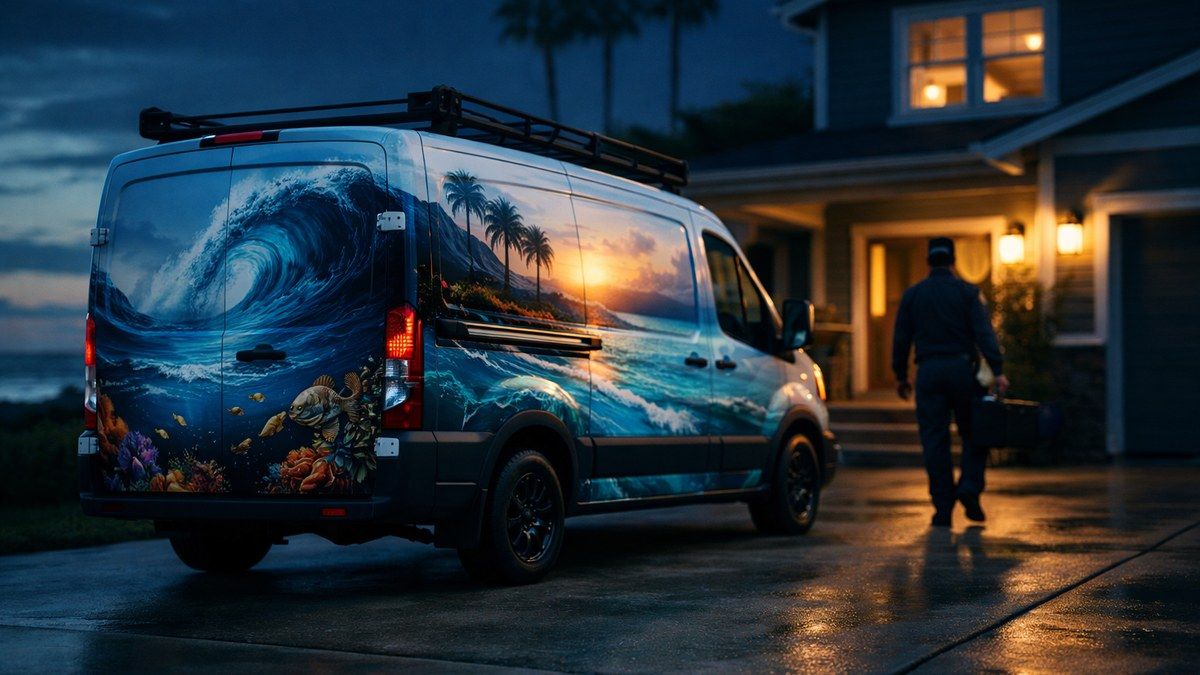

If you run a home service business, someone has probably pitched you on vehicle wrap advertising with a number attached: your truck will earn 30,000 to 70,000 impressions a day, at the lowest cost per impression of any medium. The trucks are already driving your service area, the logic goes, so why not turn them into billboards?
The idea is sound. The numbers usually quoted to sell it are not. This article covers what commercial wraps actually cost, where those famous impression statistics come from, and the break-even arithmetic that tells you whether wrapping your fleet makes sense.
What Vehicle Wrap Advertising Actually Costs
Plan on roughly $2,000 to $6,500 for a full wrap on a typical work vehicle, $600 to $2,500 for a partial wrap, and a few hundred dollars for cut vinyl lettering. The spread depends mostly on vehicle size and design complexity.
Published installer pricing gives you a usable baseline. YesWrap's 2025 commercial pricing guide puts a full wrap on a work van such as a Ford Transit at $2,500 to $4,500, a pickup at $2,000 to $3,800, and a 14-to-26-foot box truck at $3,500 to $6,500 or more (YesWrap, August 2025). Wrapmate's current rates tell a similar story, with design billed separately at $250 to $400 and removal at $130 per labor hour (Wrapmate, 2026).
Lifespan is where quotes get optimistic. Manufacturers engineer premium vinyl to last five to seven years, but YesWrap's guide is more candid: a well-installed commercial wrap typically lasts three to five years. Five years on quality film is a fair budgeting assumption, and it is the one used below. Line items owners forget:
- Design fees of $250 to $400 and up, more for custom artwork.
- Removal at roughly $130 per hour when you sell the vehicle or rebrand.
- Repairs after bodywork, since damaged panels need re-wrapped sections.
- Downtime of several business days per vehicle during installation.
Where the Famous Impression Numbers Come From
The claim that a wrapped vehicle earns 30,000 to 70,000 impressions a day traces back to a 2003 white paper from ARD Ventures that described the range as preliminary testing, without publishing the underlying data. Treat it as a marketing figure, not a measurement.
The trail matters because the number is everywhere. Trade coverage has repeated the range for over a decade (Equipment World, 2014), and a widely quoted 77-cent cost per thousand impressions circulated the same way, distributed to fleet publications by a wrap vendor rather than an independent researcher (Automotive Fleet, 2015). The ARD paper's own worked example totals about 15,000 daily impressions, well short of the headline range it made famous (Chicago Fleet Wraps' source check).
That does not mean wraps are ineffective; the credible evidence is simply more modest. Nielsen's 2019 out-of-home advertising study for the OAAA, with a national sample of 999 U.S. residents, found that 64 percent had noticed a wrapped vehicle ad in the past month and 44 percent in the past week, among the highest noticing rates in the category (Nielsen/OAAA, 2019). People do see wrapped trucks. What no national survey can tell you is how many will see yours, because that depends on your routes, your traffic, and where the vehicle sits overnight. The same caution applies to any out-of-home spend, which is why we walked through similar math for billboard advertising.
The Break-Even Math, Worked Out
A wrap pays for itself when the jobs it generates return its amortized annual cost in gross margin, and for most home service businesses that bar is low: often four to six jobs a year per vehicle.
Consider a hypothetical two-van plumbing company that wraps one van to start. The assumptions, stated plainly so you can swap in your own numbers:
- Full wrap on a work van: $3,500, mid-range for the van pricing above.
- Design fee: $350. Total outlay: $3,850.
- Useful life: 5 years, so the wrap costs $770 per year, about $64 a month.
- Average first-job ticket: $400 at a 40 percent gross margin, so each new customer's first job returns $160.
Divide $770 by $160 and the van needs about 4.8 new customers a year to cover itself on first jobs alone — one attributable call every ten weeks from a vehicle parked in your customers' driveways every working day. If a plumbing customer is worth closer to $1,200 over a few years of repeat work, break-even falls to roughly two customers a year.
The caveat: the wrap only clears this bar if those calls arrive. A truck that lives in a garage, a design nobody can read, or a company nobody can find online will all quietly turn the math negative. The next two sections deal with those failure modes.
When a Wrap Is the Right Call, and When It Is Not
Wraps reward businesses whose vehicles log real miles and real parked hours inside a defined local service area, and they punish businesses whose trucks are rarely seen or whose brand is about to change. Run your situation against this list first:
- Your trucks are out most days. A vehicle driven two days a week halves the exposure and doubles the effective cost.
- You park where people live. A van in a residential driveway for a three-hour job is advertising to the neighbors most likely to need the same work — a home service advantage billboards cannot copy.
- You will keep the vehicle at least four years. Amortization does the heavy lifting above; wrapping a van you will replace in eighteen months roughly triples the annual cost.
- Your name and brand are settled. A pending rebrand makes a wrap an expensive thing to redo. Sort the brand first; our brand development work exists for this sequencing problem.
- Your online presence can catch the demand. Most people who see your truck will not call the number on the door; they will search your name later. A thin Google Business Profile or a weak website sends those searches nowhere.
The wrong-fit cases are just as clear. Skip or defer the wrap if you subcontract under a general contractor who controls on-site branding, if your vehicles are short-term leases, or if the same money is needed to fix a website that is losing customers you already attract. A wrap is a multiplier on an existing marketing strategy, not a substitute for one.
The Design Mistakes That Waste the Money
Most underperforming wraps fail at the design stage, not the installation stage, and the failures follow a pattern: too much information, displayed too small, for viewers who have three seconds to take it in.
A wrapped truck is read at 45 miles an hour or from across a parking lot, so the design brief is closer to a highway sign than a brochure. The recurring mistakes:
- Too much text. A passerby can absorb a name, one line about what you do, and one way to reach you. Twelve services in small type read as noise.
- No instant answer to "what do they do?" If the company name is clever rather than descriptive, the wrap must state the category plainly: plumbing, roofing, electrical.
- Unreadable contact details. Phone numbers and web addresses need to be legible at distance, which means larger and fewer. A long email address on a tailgate is decoration.
- Low contrast. Dark logos on dark vehicles disappear in traffic. Contrast outperforms cleverness.
- Cheap film and installation. Peeling corners advertise something, just not what you intended, and a year or two of extra life from quality film changes the amortization math in its favor.
How to Measure Whether Your Wrap Is Working
A wrap becomes measurable the day you give it its own tracking phone number, its own short web address or QR code, and a standing habit of asking every new caller how they heard about you.
None of this is exotic. A tracking number that forwards to your main line costs a few dollars a month and counts exactly how many calls the truck produced; we covered the setup in our guide to call tracking for small businesses. A short, memorable URL on the wrap, redirecting to your site with campaign tags, does the same for web traffic. The lowest-tech signal is still the most reliable: train whoever answers the phone to ask where the caller found you, and log "saw your truck" in whatever system tracks your jobs. Watch branded searches too — in Nielsen's research, more than four in ten smartphone users who acted on an out-of-home ad searched for the advertiser online, so a climb in searches for your company name after the fleet gets wrapped is part of the return.
Give it a full year before judging. Exposure compounds slowly as the same households see the same truck repeatedly, and a season of weekly sightings often converts only when the water heater finally fails.
Frequently Asked Questions
How long does a commercial vehicle wrap last?
Plan on three to five years for a professionally installed wrap on quality vinyl, even though premium films are engineered for five to seven. Sun, pressure washing, and outdoor parking shorten the real-world figure, and budget film or a rushed installation can show peeling within a year, so installer selection matters as much as film brand.
Does a wrap damage the paint underneath?
On factory paint in good condition, no. Professional removal is designed to leave the original finish intact, and vinyl actually shields paint from sun fade while it is on. The risk comes with repainted panels or damaged clear coat, where removal can lift weak paint. Expect roughly $130 per hour for professional removal.
Should I start with a full wrap or a partial wrap?
If the budget is tight, a well-designed partial wrap or bold lettering on every vehicle beats one fully wrapped truck and three plain ones. Coverage across the fleet multiplies sightings, and a clean partial with a readable name, category, and phone number does most of a full wrap's work at a third to half the cost.
How many impressions does a wrapped truck really get per day?
No universal number exists. The widely quoted 30,000 to 70,000 figure comes from a 2003 white paper that never published its test data, and the paper's own example worked out to about 15,000. Real exposure depends on miles driven, traffic on your routes, and hours parked in visible spots, so estimate from your own operations.
Is a vehicle wrap tax deductible for my business?
Wrapping a business vehicle is generally treated as an advertising expense, which makes the cost deductible for most companies, though the vehicle's other operating costs do not become deductible just because it carries your logo. Rules vary with how the vehicle is owned and used, so confirm the treatment with your accountant first.
Put This to Work in Your Business
Style Strand Media helps home service companies in North Myrtle Beach and across the Grand Strand, along with remote clients, build marketing plans where every dollar is measured, from the trucks on the road to the searches they trigger.