
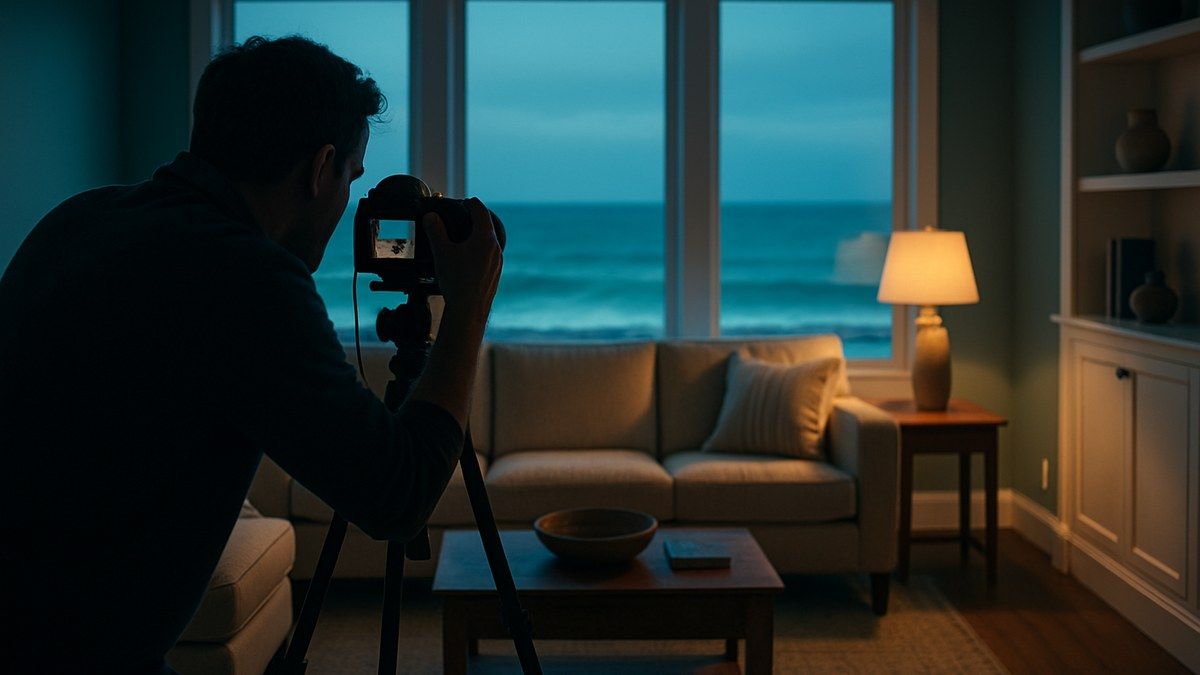

Guests cannot walk through your property before booking — vacation rental photography and listing copy are the walkthrough. Every booking your company takes was won or lost on a screen of thumbnails and a few hundred words, which makes listing content the highest-leverage conversion work in the business.
The economics justify treating it seriously. A professional shoot costs a few hundred dollars per property; the property earns tens of thousands a year. A listing that converts even modestly better compounds across every channel the property appears on: your direct booking site, Airbnb, Vrbo, Google.
This is the working standard we apply across rental portfolios: the shot list and sequence, description structure, the accuracy discipline that protects reviews, headline formulas, and the refresh calendar that keeps it all current.
The Vacation Rental Photography Shot List — and the Order That Sells
A converting gallery is 25 to 35 photos shot from a deliberate list and arranged so the first five win the click. Guests scroll fast; the opening sequence decides whether they ever reach photo six.
The shot list
- Hero shots (3–4): the best exterior or view, the main living area at its widest, and the single feature that defines the property — oceanfront balcony, private pool, the great room that fits three families.
- Every bedroom (2 per room): one wide establishing shot, one detail. Who sleeps where is the first logistics question every group solves.
- Every bathroom (1 each): guests count them and check condition. Skipping a bathroom reads as hiding it.
- Kitchen (2–3): wide shot plus evidence of real capability — full-size appliances, the coffee setup, enough seating. Rental guests cook; the kitchen sells week-long stays.
- Outdoor living (2–4): balconies, decks, grills, pools, and the walk to the beach, shot at the time of day they look best.
- Amenity proof (2–4): the washer-dryer, the parking situation, the elevator, the beach gear closet — the practical questions that otherwise become pre-booking phone calls.
- Context (1–2): the building or complex, and the view from the door toward the water. Guests want to place the property in the world.
Execution standards
Shoot horizontal at high resolution, in natural light with every lamp on, staged simply — beds made tight, counters clear, toilet lids down, no personal clutter. Wide-angle enough to show rooms honestly, not so wide that the guest arrives to rooms half the size they expected; a distorted photo converts once and reviews badly forever. Twilight exteriors are the one artistic indulgence that reliably pays: a warm dusk hero shot outperforms the same building at noon.
Then sequence for the scroll: hero, living space, primary bedroom, kitchen, signature amenity — the emotional close in five frames — followed by the systematic walkthrough for the guests who are now seriously evaluating.
Writing Descriptions That Sell the Experience
A converting description sells the stay in its first third and documents the property in the rest. Guests read the opening to feel whether this is their vacation, then skim the remainder to verify logistics — write for both readers, in that order.
The opening third: the experience
Lead with the two or three genuine differentiators, written as moments rather than features. Not "4BR/3BA oceanfront condo with balcony" — the search result already said that — but coffee on the balcony while the sun comes up over the Atlantic, five minutes from bed to sand, the table that seats all twelve of you for the shrimp you bought at the dock. Concrete and specific beats lyrical: name the pier you can see, the minutes to the beach access, what the sunrise actually looks like from that particular balcony.
The remaining two-thirds: the facts
- Sleeping arrangements, bed by bed: "Primary: king. Bedroom 2: queen. Bedroom 3: two twins. Sleeper sofa in den." Groups assemble their sleeping chart before they book; make it effortless.
- Kitchen and practical capability: what is actually equipped, laundry, Wi-Fi speed (a number, for remote workers), TVs and streaming.
- Location with distances: steps or minutes to beach access, and drive times to the landmarks your guests actually name.
- Parking, elevators, stairs, and check-in logistics — the questions your reservations team answers by phone all day belong in the listing.
- House rules and quirks stated plainly: no pets, minimum age, the parking limit, the road between building and beach.
Use short paragraphs and scannable lists, and write in second person throughout — the guest is picturing their own family in the rooms. On your own direct booking site you control the format completely, which is one more argument in the case we lay out in why your company needs a direct booking website: your property page should always out-inform the OTA version of itself.
Amenity Accuracy: The Trust Layer Behind Every Review
Every listing is a promise, and reviews are the enforcement mechanism — so accuracy is not an ethics footnote, it is conversion strategy. The single most common root cause of negative vacation rental reviews is not a bad property; it is a gap between what the listing implied and what the guest found.
The expensive failure pattern is always the same: the "oceanfront" unit that is actually ocean-view across a road, the hot tub that is closed half the year, the "sleeps 10" that means four in beds and six on air mattresses, the renovation photos from two furniture generations ago. Each overstatement wins the booking, then converts a paying guest into a public critic — and one refund demand or two-star "not as advertised" review costs more than honesty ever would have.
The discipline that prevents it:
- Audit against reality annually. Walk each property (or have inspectors do it) with the listing open. Anything present in the copy or photos but absent in the unit gets fixed in one direction or the other.
- State the quirks before guests discover them. Third-floor walk-up, compact second bathroom, lively street on summer weekends. Disclosed upfront, a quirk filters out the wrong guests; discovered on arrival, it headlines the review.
- Mine your reviews and inquiry calls for gaps. Any question two guests ask, and any surprise one review mentions, is a listing defect. Fold the answer into the copy that week.
- Date-stamp seasonal amenities. "Pool heated March 15–October 31" prevents the January guest from reviewing you for a cold pool you never promised warm.
The compounding payoff: honest listings earn better reviews, and better reviews raise conversion and search placement on every channel. Trust is the asset; the listing is where it is either built or borrowed against.
Headline Formulas That Earn the Click
A listing headline has one job: win the click against a page of similar thumbnails by stating a concrete differentiator, not an adjective. "Beautiful beach condo" describes every result on the page; specificity is the entire game.
Four formulas cover most properties:
- Signature feature + property + location: "Oceanfront Corner Condo with Wraparound Balcony — Crescent Beach." Lead with the thing competitors on the page cannot claim.
- Capacity + occasion: "Sleeps 14 Under One Roof — Reunion House 2 Blocks to the Beach." Large-group shoppers filter by capacity; naming the occasion tells them this is their property.
- Distance or access: "Steps to the Sand: Ground-Floor Condo, No Elevator Waits." Proximity in literal terms — steps, feet, one block — is the most-searched differentiator on the beach.
- Audience + benefit: "Golfers' Base Camp: 3BR Villa, 10 Minutes to 8 Courses" or "Pet-Friendly Cottage with Fenced Yard." Name the guest and the headline pre-qualifies its own clicks.
Mechanics that raise clicks across all four: front-load the differentiator (truncation cuts endings, so the first 30 characters must carry the message), use numerals, skip filler adjectives and all-caps, and never spend headline space on facts the search result already displays. Then test deliberately — change one property's headline, watch click-through for a month against its baseline, and keep the winner. Headlines are the cheapest A/B test in the portfolio.
Refreshing Listing Content Seasonally
Vacation rental photography and listing copy are not a one-time project — a full annual audit plus two to four seasonal refreshes keeps every property selling what guests are currently shopping for. Static listings decay quietly: photos drift out of date, copy misses the season, and channels reward recently updated content.
Split the work into two rhythms:
The annual audit (once, in the off-season)
Reshoot anything renovated or refurnished, verify every amenity claim against the walkthrough, rewrite descriptions that have accreted patches into something coherent, and check that headlines still reflect each property's strongest differentiator. Winter is the natural window in beach markets, before spring booking season opens.
The seasonal refresh (quarterly, lightweight)
- Swap the hero image and opening lines to match the booking season, not the calendar season. In January, shoppers are buying summer — lead with bright beach imagery. In August, fall shoppers respond to golf, festivals, and empty-beach couples' angles; by October, snowbird shoppers need monthly-stay language, workspace photos, and the heated-pool date range.
- Rotate seasonal proof points: the September water temperature, the holiday lights nearby, spring golf packages — the same seasonal logic that drives shoulder season campaigns applies to the listings those campaigns land on.
- Update anything reviews or guest questions surfaced that quarter — the continuous accuracy loop from the audit, run in miniature.
Make it operational: a per-property checklist, a named owner, and calendar dates — the same discipline as any recurring content marketing program. An hour per property per quarter is the realistic cost. Set against what these listings earn per booked week, it is the best-paid hour in the company.
Frequently Asked Questions
How many photos should a vacation rental listing have?
Aim for 25 to 35 well-chosen photos. Fewer than 20 leaves guest questions unanswered — and unanswered questions become abandoned bookings or support calls. More than 40 buries the shots that sell. Order matters as much as count: the first five photos decide whether anyone sees the rest, so lead with the hero exterior or view, the main living space, the primary bedroom, the kitchen, and the standout amenity.
Is professional photography worth it for a vacation rental?
Yes, and it is usually the highest-ROI content spend a rental operator makes. Professional interior photography typically costs 150 to 400 dollars per property and lifts listing click-through and conversion enough to pay for itself within the first one or two incremental bookings. Photos are the product page for a four-figure purchase; phone snapshots with bad lighting tax every booking the listing ever takes.
What should a vacation rental description actually say?
Lead with the two or three things that make this property the right choice — the view, the walk to the beach, the space for a big family — written as the experience of staying, not a feature list. Then cover the practical facts guests verify before booking: sleeping arrangements bed by bed, kitchen capability, parking, distances, and anything unusual. Sell the stay in the first third; document the details in the rest.
Why does amenity accuracy matter so much in listing content?
Because the listing is a promise, and reviews are the enforcement mechanism. An overstated listing — an oceanfront that is actually across the road, a listed hot tub that is seasonal — produces disappointed guests, negative reviews, and refund demands that cost far more than honesty would have. Accurate, even self-deprecating candor about quirks builds trust, filters out mismatched guests, and consistently earns better reviews from the guests who do book.
How often should I update vacation rental photos and listing content?
Do a full audit once a year and a seasonal refresh two to four times a year. The annual pass catches outdated photos after renovations, changed furnishings, and stale copy. Seasonal refreshes swap hero images and opening lines to match what guests are shopping for — bright beach-season shots in spring listings, cozy off-season angles and monthly-stay language in fall. Listings that never change quietly decay in both conversion and search placement.
Put This to Work in Your Business
Style Strand Media manages listing content programs — photography direction, descriptions, and the refresh calendar — as part of full vacation rental marketing engagements for operators on the Grand Strand and, remotely, in any market. We are based in North Myrtle Beach; if your listings have not changed since they were written, we should talk.