
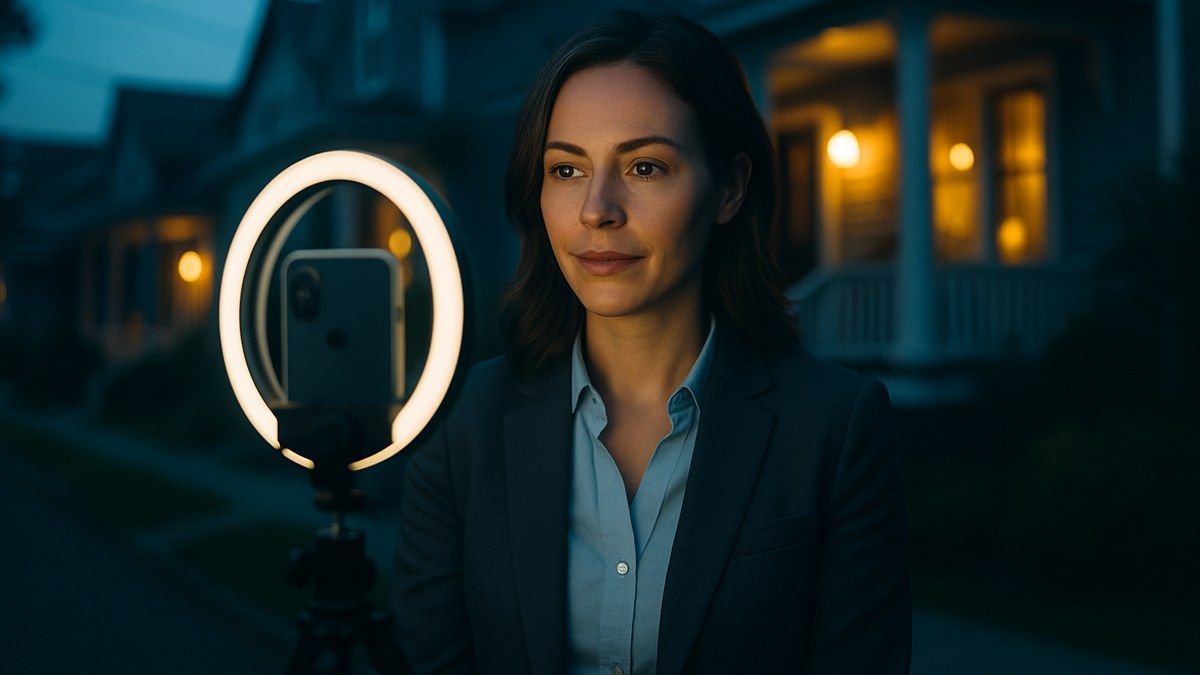

Most real estate agents treat social media like a listing portal: new listing, price cut, just sold, repeat. Followers learn to scroll past it, and the account quietly stalls. Social media for real estate agents works differently: the agents who get business from it post listings sparingly and spend most of their effort proving, week after week, that they know their market and are worth referring.
The stakes are real. In the National Association of Realtors' 2025 Technology Survey, 75% of agents use social media, and it beat every other channel (CRM, MLS, brokerage website, paid ads) as the source of highest-quality leads, named by 39% of respondents (HousingWire, 2025). Three-quarters of your competitors are posting; a much smaller share are posting anything a future client would remember.
Why a listings-only feed fails
A listings-only feed fails because your followers are not in the market. The overwhelming majority of the people who follow you are not buying or selling a house this month, so a feed of listings is irrelevant to them. Engagement drops, and the platform shows your posts to fewer people.
The math of how agents actually get hired makes the same point. Per NAR's 2025 Profile of Home Buyers and Sellers, 88% of buyers purchased through an agent, 43% found that agent through a referral from a friend, neighbor, or relative, and another 18% reused an agent they'd worked with before. Roughly six in ten buyers never really shopped for an agent; they hired the one their circle already trusted. Your social channels are not a storefront for strangers. They are the machine that keeps you visible and credible to the people who will one day be asked, "do you know a good agent?"
Listings still belong in the mix, since they prove you have business, but as seasoning, not the meal. A useful rule of thumb is 40/40/20: roughly 40% local and market expertise, 40% education and personality, 20% listings and transaction announcements.
The five content pillars that earn attention
Five kinds of content consistently work for agents: local expertise, market education, process education, behind-the-scenes, and social proof. Rotating through all five keeps your feed useful to people years away from a transaction, which is most of your audience.
- Local expertise. Neighborhood tours, "what $400K buys here vs. there," new restaurants and developments, school-zone and commute realities. Only a local can make this content.
- Market education. What's happening in your market this month (days on market, inventory, price trends) translated into what it means for a buyer or seller. NAR's 2025 Profile found first-time buyers fell to 21% of the market, a record low, at a median age of 40. That's a post: what it takes to buy your first home in your area right now.
- Process education. Inspections, appraisal gaps, earnest money, closing costs, what a listing appointment covers. Answer the questions clients ask you in person; thousands of people type the same ones into Google and TikTok.
- Behind-the-scenes. A day of showings, staging a listing, the 6 a.m. sign install, what you do between contract and closing. People refer people, not logos; this pillar is why they remember you specifically.
- Social proof. Closing-day photos (with permission), milestones, reviews clients actually wrote. Never invent or embellish results; one sharp-eyed neighbor can undo years of credibility.
Twenty post ideas that aren't listings
Keep a standing list for the days you draw a blank. Twenty ideas, mapped to the pillars above, that work for most agents:
- 60-second neighborhood tour: park, coffee shop, typical street, typical price
- "Three things surprising buyers in [your town] this month"
- This month's numbers: median price, days on market, what changed and why it matters
- "What $350K / $500K / $750K buys right now" comparison
- First-time buyer myth vs. reality (you don't need 20% down)
- Walk-through of what happens at a home inspection
- "What I check in the first five minutes of a showing"
- Renovations that return money at resale in your market, and ones that don't
- The timeline: offer accepted to keys, step by step
- What sellers should do the week before photos
- A local business you love and why (tag them; they'll often share it)
- Seasonal: hurricane prep, holiday events, best sunset spots
- "Questions to ask before hiring any agent, including me"
- Behind the scenes of prepping a listing for launch
- Your morning: previews, calls, a deal saved at the eleventh hour (no client names)
- Closing-day photo with a line about what the client overcame (with permission)
- A review, screenshotted, with a sentence of context
- "Mistakes I see buyers make in multiple-offer situations"
- How earnest money, due diligence, and deposits actually work locally
- Poll or question box: "Which neighborhood should I tour next?"
None of these require a new listing, a drone, or a videographer — only what you already have: judgment about your market.
A weekly cadence you can actually sustain
Four posts a week, batched in one monthly filming block, beats daily posting that collapses after three weeks. Consistency over months builds recall; intensity that burns out builds nothing.
- Pick your platform pair. One primary (usually Instagram or Facebook, where your sphere lives), one secondary (YouTube or TikTok for reach, LinkedIn if you work relocation or investors). Ignore the rest without guilt.
- Batch-film monthly. Block two hours and film six to eight short videos from the idea list above. Same shirt is fine; nobody notices. Phone camera, window light, captions on.
- Schedule weekly. Monday market note, Wednesday education video, Friday local or behind-the-scenes, weekend listing or social proof. That's the 40/40/20 mix on autopilot.
- Spend 15 minutes a day on replies. Answer every comment and DM the same day. The lead is rarely the post itself; it's the conversation the post starts.
- Repurpose. The Wednesday video becomes a Reel, a YouTube Short, and three sentences for your email list.
If even this feels heavy, start with two posts a week from the two pillars you enjoy. A thinner cadence you keep beats a full one you abandon. Our playbook on Instagram Reels for local businesses covers the filming side in more depth.
What the algorithms reward in 2026
Platforms now reward watch time and shares, not follower counts. Instagram head Adam Mosseri has confirmed the top ranking signals are watch time, likes, and sends: how often people watch to the end and forward a post to a friend (Hootsuite, 2026).
For an agent, that has three practical consequences. First, the opening two seconds decide everything: start with the payoff ("This $410K house has a problem you can't see in photos"), not with "Hey guys!" Second, make content people send to someone. A "thinking of moving here?" video gets forwarded to the friend who is, and that send is both the modern referral and exactly the behavior the platform promotes. Third, post original material: Instagram down-ranks recycled, watermarked content, so reposting another account's viral clip does less than a rougher video you filmed yourself. Keep videos under three minutes and turn captions on, since much viewing happens muted.
One caution specific to real estate: fair housing rules apply to social posts just as they do to ads. Describe the property and the area's amenities, never the people who "should" live there, and steer clear of commentary on the makeup of a neighborhood.
Measuring social media for real estate agents (and its limits)
Measure social media by conversations and appointments, not followers. If a quarter of consistent posting hasn't produced a single DM, comment thread, or "saw your video" mention that turned into a real conversation, change the content or change the priority.
Consider a hypothetical agent closing 20 transactions a year with 1,500 followers, mostly past clients and local connections. Four posts a week at a modest average reach of 250 accounts is roughly 52,000 impressions a year aimed at the exact group most likely to refer. Suppose that visibility prompts just two extra referral-style conversations a month, and one in six becomes a closed deal within a year: that's four additional transactions, 20% growth, for about three hours a week and no ad spend. Your numbers will differ; the mechanism is the point. Social media multiplies referrals. It rarely replaces them.
And sometimes it's the wrong tool. If you have no reviews, an outdated Google Business Profile, and no follow-up system for the leads you already get, fix those first; otherwise social media pours water into a leaky bucket. It's also the wrong priority if you'll only do it for six weeks, because the compounding is the product. Agents who hate being on camera shouldn't force it: carousels, market graphics, and written local guides work, just more slowly. For where social fits among the other channels, see our guide to real estate local search and our real estate marketing services page.
Frequently Asked Questions
How often should a real estate agent post on social media?
Three to four times a week is enough on your primary platform, provided you sustain it for months and answer comments daily. Frequency matters less than consistency and replies: a year of steady posting builds more referral recall than a one-month daily sprint followed by silence. Batch-film monthly so a busy closing week doesn't break the streak.
Do real estate agents need to be on TikTok?
No. TikTok rewards reach among strangers, which suits agents in relocation-heavy markets, but most agents earn more from Instagram and Facebook, where their past clients and local sphere already are. Add TikTok only after your primary platform is consistent; the same short vertical video can usually be posted to both.
Should agents use AI to write their social media posts?
As a drafting assistant, yes. NAR's 2025 Technology Survey found 46% of agents already use AI for listing descriptions. But generic AI captions read like everyone else's. Feed it your specifics: this month's local numbers, the question a buyer asked you yesterday, your actual opinion. Use AI for structure and speed, and keep the local judgment — the only part clients can't get elsewhere — yours.
How long does it take for social media to produce real estate leads?
Expect conversations within one to three months and closed business in six to twelve. Referral-type leads from people who already know you come first; stranger leads from search and Reels take longer. If ninety days of consistent posting has produced zero conversations, revisit the content mix before concluding the channel doesn't work.
Can I just run ads instead of posting organic content?
Ads and organic content do different jobs. Ads buy reach on demand, which is useful for listings and open houses, but people who click will check your profile before they call, and an abandoned feed costs you the conversion. A working pattern: organic content builds the credible profile, modest ad spend puts your best posts in front of more locals.
Put This to Work in Your Business
Style Strand Media builds content systems, short-form video, and social media programs for real estate professionals on the Grand Strand, from North Myrtle Beach to Murrells Inlet, and for remote clients nationwide.